
11% Off
Route Length
Max Altitude

Trek Duration
Trek Difficulty
Base Camp Area

Pickup Point
10+ Years Age
First timer can apply, previous trekking experience is more appreciated.
Cover 5 km of distance in 30 minutes without a stress.
+917055048487, +917055048488
trekkingcompass@gmail.com
The Rupin Pass Trek is not just a journey across landscapes; it’s a story of surprises, contrast, and breathtaking beauty, every step of the way. Nestled in the heart of Himachal Pradesh, this high-altitude Himalayan adventure offers one of the most picturesque and thrilling trekking experiences in India. Starting from the quaint village of Bawta, with its charming Kath-Kuni wooden houses, the trail winds through an ever-changing canvas: lush oak and rhododendron forests, cascading waterfalls, high-altitude meadows, snow bridges, and glacial valleys. But it’s not just the terrain that keeps you engaged, it’s how suddenly and dramatically it transforms.
Just as the drive from Rohru over Chainsheel Pass sets the tone with shifting views and unpaved forest trails, the trek itself continues to amaze. Jakha, known as the “Hanging Village,” perched steeply on a ridge, is the last human settlement before you dive deeper into the wilderness. From here, the surprises come quickly, whether it’s trekking through the red-and-pink-dotted rhododendron forest of Buransh Kandi or emerging into the flower-drenched expanse of Dandreyash Thatch. And then comes the star of the show: the Rupin Waterfall. A massive, multi-tiered fall with a staggering drop of 1,500 feet, it not only steals the spotlight but also becomes part of the trail as you ascend beside it.
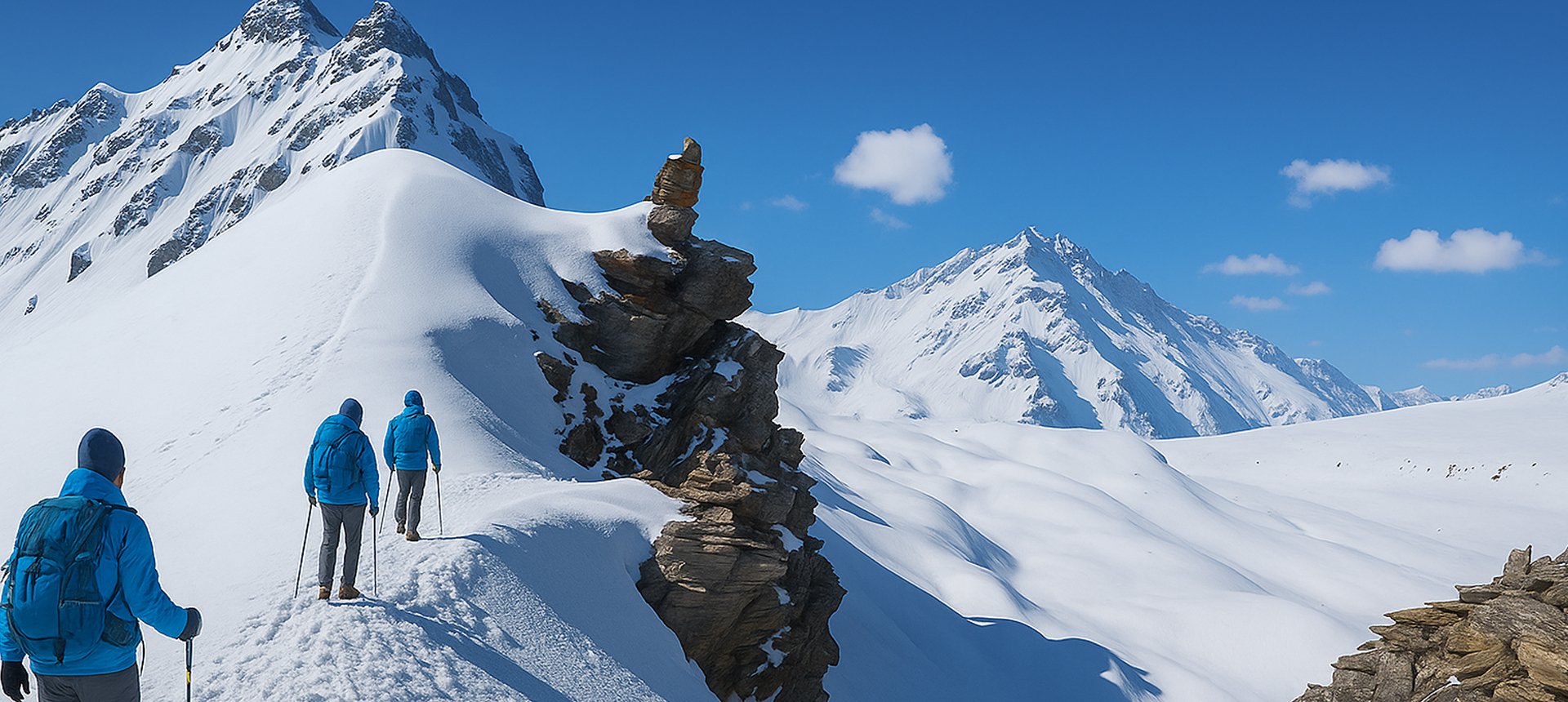
The real adventure, however, begins as you climb through snow-covered paths toward Rupin Pass, sitting at an elevation of 4,663 meters (15,300 ft). The narrow Rupin Gully and vast snowfields of Rata Pheri offer both thrill and awe. As you push toward the knife-edged pass and begin your descent into Sangla Valley, apple orchards and the gentle Baspa River await, marking a gentle end to an otherwise wild journey.
With panoramic mountain views, dramatic scenery shifts, cultural richness, and challenging terrain, the Rupin Pass Trek stands out. It uniquely blends beauty and adventure, offering trekkers a truly unforgettable experience.
Jiskun Altitude: 7,660 ft (2,335 m)
Altitude Gain: 420 ft (128 m)
Travel Distance: 190 km
Travel Hours: 7-8 hrs
The journey starts on winding roads through Himachal’s deodar-laced hills. Shimla fades behind you as apple orchards and pine forests take over. The long drive to Jiskun has a charm of its own; villages stacked on slopes, rivers racing alongside, and air that gets crisper with every mile. You slowly gain altitude, but you barely feel it. Around every bend, the Dhauladhars tease you with their distant silhouettes.
By the time you reach Jiskun, the buzz of the city is long gone. The village sits quietly at 7,660 ft, with wooden houses and smiling locals. You’ll notice how everything slows down here. The sun sets early.
Conversations happen without phones. It’s the kind of place where you sleep early, not because you have to, but because it feels right.
Jakha Altitude: 8,990 ft. (2,740 m)
Altitude Gain: 1,330 ft (405 m)
Travel Distance: 3.8 km
Travel Hours: 4 hrs (approx.)
Today’s trail takes you into the forest and out of the familiar. The path from Jiskun dips and rises, sometimes gently, sometimes not. But it’s the silence that walks with you, which is broken only by the rustle of leaves or the clinking of cowbells. This is where the real trek begins.
Jakha comes up slowly, tucked against a hill like a secret. They call it the last village of the trek. With stone paths, slate roofs, and a temple that looks older than memory, Jakha is simple and stunning. At 8,990 ft, it’s cooler, quieter, and oddly comforting. Locals here will offer you tea without asking your name, and somehow, that feels enough.
Dandreyash Thatch Altitude: 11,720 ft (3,572 m)
Altitude Gain: 2,730 ft (832 m)
Travel Distance: 11 km
Travel Hours: 7-8 hrs (approx.)
From Jakha, the forest deepens. It’s thick, green, and alive. Wooden bridges cross over gurgling streams, and now and then, the canopy opens just enough to reveal the Rupin River far below. You climb steadily, and somewhere along the way, you realize you haven’t checked your phone in hours. And you don’t want to.
The final stretch brings you into the open. Dandreyash Thatch sits like a carpet of green spread wide under an open sky, wherein wildflowers peek out. Mountains circle in close. At 11,720 ft, the air thins, but your thoughts feel lighter. This place has no walls, no sounds of machines, just wind brushing grass and clouds rolling in. Sleep comes easily tonight.
Upper Waterfall Altitude: 13,250 ft (4,039 m)
Altitude Gain: 1,530 ft (466 m)
Travel Distance: 2.1 km
Travel Hours: 7-8 hrs (approx.)
You start early. The valley narrows, and the Rupin River now travels beside you. No more as a trickle, but as a bold, icy companion. The trail is wild. Meadows turn into rocky patches, and the incline gets steeper. You’ll find snow bridges, patches of slippery stone, and the sound of rushing water getting louder with every step.
Then, you see it, the famous Rupin Waterfall. Majestic and multi-tiered, it falls with a roar that silences everything else. The campsite is just above the waterfall, perched at 13,250 ft. You’re close to the snowline now, and every breath feels earned. Tents are pitched under a sky so clear that even the stars look closer. It’s the last night before the pass. And somehow, you feel ready.
Rupin Pass Altitude: 5,300 ft (4,663 m)
Ronti Gad Altitude: 12,800 ft (3,901 m)
Altitude Gain: 2,050 ft (625 m)
Altitude Loss: 2,500 ft (762 m)
Travel Distance: 11 km
Travel Hours: 10 hrs (approx.)
This is the day everything builds up to. The climb to Rupin Pass is long, slow, and surreal. You leave the waterfall behind and step into the snow. Every footstep now lands on crunching ice or shifting slush. The oxygen thins, and your pace drops, but strangely, you don’t mind. The silence here feels sacred.
The trail zigzags up the slope. On one side, snow walls rise high. On the other hand, valleys drop away. And finally, you reach the top, Rupin Pass at 15,300 ft. There are no flags, no crowds. Just wind, views, and a feeling you can’t name.
Ahead of you is a stretch of snow leading down into a new world.
The descent to Ronti Gad is steep and technical. Rocks, ice, and scree make every step a mindful one. But the views keep you going. The landscape shifts again—what was white and harsh becomes soft and green by the time you reach Ronti Gad at 12,800 ft.
This campsite is tucked into a gentle basin, with grassy slopes and peaks all around. After the day you’ve had, it feels like a reward. The body aches, but the heart’s full. Tonight, sleep doesn’t just come; it embraces you in the memories of a day well spent.
Sangla Altitude: 8,710 ft (2,655 m)
Shimla Altitude: 7,240 ft (2,207 m)
Altitude Loss: 4090 ft (1,247 m) + 1,470 ft ( 448 m) = 5,560 ft (1,695 m)
Travel Distance: 11 km (trek) + 220 km (drive) = 231 km
Travel Hours: 6 hrs + 7 hrs (13 hrs approx.)
The last leg is both peaceful and pensive. The trail from Ronti Gad to Sangla is mostly downhill, easy on the lungs, tough on the knees. The snow disappears fast. You pass grazing yaks, wooden shelters, and rhododendron patches that smell faintly sweet.
As you descend 5,560 ft, the silence begins to shift. Villages return. So does the hum of roads. And before you know it, you’re in Sangla, a beautiful valley town wrapped in orchards and tall peaks. It’s a soft landing after six days of raw nature.
The drive back to Shimla is long, but you’ll be quieter now. It’s not just fatigue. It's a reflection. The Rupin Pass Trek leaves you with questions, answers, and memories that stick. And once you reach Shimla again, it’ll hit you, this wasn’t just a trek. It was a reset.
Accommodation
Meals (Vegetarian only with eggs option available)
Nutritious meals from Day 1's dinner to last day's breakfast, following the itinerary schedule.
Expert Support
First Aid Preparedness
Fully equipped medical kit including a stretcher, oxygen cylinder, blood pressure monitor, oximeter, and stethoscope to ensure safety throughout the journey.
Storage Facilities :- A secure room at the base camp to store additional luggage not needed during the trek.
Permits and Entry Fees :- Coverage of all necessary permits and entry fees, in line with standard charges for Indian nationals.
Transportation :- A round-trip transport from the pick-up point and back at the same point as a part of the itinerary.
Trek Equipment
Insurance :- Personal insurance is mandatory and not included in the package.
Personal Expenses :- Any expenses of a personal nature, including shopping, snacks, hiring a mule or porter for carrying your belongings, or acquiring personal equipment.
Emergency Costs :- Expenses arising from emergency evacuations, hospitalization, or any medical treatments required.
Unspecified Services :- Any services or items not explicitly mentioned under the "INCLUSIONS" section.
Food Costs :- We will not cover any food costs during your transit to and from the base village.
Trekking is not only about enjoying the change of scenery but also about being responsible. Our (Trekking Compass) responsibility is to provide you with an opportunity for a safe trek. But, how do we do that? We do that when you fulfill your end of the responsibility and are honest with us. To keep you safe we need to be sure there isn’t any inherent threat to your being.
Treks are at higher altitudes and it becomes difficult, almost impossible to provide you with immediate medical assistance. Therefore, we cannot help you if you don’t help us. Trekking is only one of the things you can do, but there are plenty of other things to do too. Don’t risk your life for the thrill.
To approach a trek with utmost safety, we want you to submit the following documents:
Personal Confirmation Statement (Compulsory for anyone over 18 years)
You are participating in a trek at high altitudes and it comes with its own sets of risks. This Personal Confirmation Statement will make sure that you understand all the risks you're buying into. Trekking Compass wants you to confirm your complete understanding of these risks so that you come prepared for any mental or physical challenges ahead.
This statement is also a declaration from you that, "All the information I have provided, including medical conditions, is true. If found false under any circumstances, I will be held accountable and it has nothing to do with Trekking Compass."
We have the utmost empathy for you and will do our best to help wherever possible, but only after assessing your readiness and safety for the trek. This is how our team will adequately prepare for whatever risks we might face during the journey. Concerning individuals are requested to thoroughly cross-check the requirements and only then sign the document.
Parent/Guardian Approval Statement (Compulsory for anyone below 18 years)
For participants under 18 years of age, the Parent/Guardian Approval Statement is essential to confirm that a legal guardian understands and consents to the participation in the trek. Once we have this document, we are affirmed that the parent or guardian is fully aware of the risks involved in trekking at high altitudes and is consenting to their child's participation.
No underage (below 18+) children are welcome on the trek without their parent's consent. Submission of this document reassures us that parents are approving that their child meets the health and fitness requirements for the trek, after a thorough examination.
This legal confirmation holds the parent liable for any discrepancies, freeing Trekking Compass from any liabilities for the same. Parents are requested to thoroughly cross-check the requirements and only then sign the document.
Medical Liability Waiver
The Medical Liability Waiver makes sure participants acknowledge the health risks associated with trekking at high altitudes. Common ailments during treks include altitude sickness, dehydration, muscle cramps, hypothermia, and fatigue, all of which can significantly affect your trekking experience. Additionally, weather changes and the physical demands of the terrain may exacerbate pre-existing conditions.
If you have pre-existing medical conditions such as asthma, diabetes, or heart issues, it’s vital to inform us and carry your necessary medications. Trekking Compass cannot provide immediate medical assistance in remote areas, so having the essential medications, such as inhalers, insulin, or any other prescriptions, is crucial for your safety during the trek.
By signing this waiver, you confirm that you are in good health and have taken the necessary precautions. You acknowledge these risks and agree not to hold Trekking Compass liable for any medical issues or accidents that may arise during the trek.
For any further doubts about anything mentioned above, below is our contact information:
OFFICE ADDRESS: Lane No. 4 Krishna Vihar Mohkampur, Dehradun, Uttarakhand, 248005
PHONE NUMBER: +91 7055048487, 7055048488
EMAIL ADDRESS: info@trekkingcompass.com
Shimla (How to Reach)
There are multiple ways to reach Shimla, and different permutations and combinations might work better for different people. The Rupin Pass trek begins at Jiskun, which you reach by a local cab/jeep from Shimla (190 km, 8 hours). Trekking Compass’ team meets you at Shimla, and the journey forward is all our concern.
Treks in Himachal always come with their fragile weather and terrain. A buffer day is essential to avoid unexpected disruptions. If it remains unused, you can spend it exploring Shimla.
The trek itself spans 6 days and 5 nights, but we recommend keeping 7 days and 6 nights free in your schedule. Any day, you might need that extra day, and it won’t be a waste in any case.
Shimla from Delhi/Chandigarh
For those with a bus as a choice of travel, the best route to Shimla is from your place (anywhere in India) to Delhi /Chandigarh, and then a bus to Shimla. Trekkers from nearby states are welcome to try alternate routes. But for the majority, Delhi/Chandigarh remain the best options, and here’s why:
Medium: BUS
Delhi to Shimla:
Chandigarh to Shimla:
Several state-run and private operators provide comfortable AC Volvo bus services. Opting for government-operated buses is advisable. They avoid delays and adhere to schedules, thus being more reliable than private operators.
Note: Book early to reach the Shimla Bus Stand before 6:00 am.
Medium: TRAIN
Delhi to Chandigarh to Shimla (Time Efficient):
16 trains daily leave Delhi for Chandigarh, and you can catch any. This allows you to reach Chandigarh in time to catch the bus to Shimla Bus Stand (110 km, 4 hrs). Here are the details for the trains from Delhi to Chandigarh:
Duration:
Timings: Departure starts at 4:15 am and continues till 11:20 pm.
Primary Stations: NDLS (New Delhi), DLI (Old Delhi), NZM (Hazrat Nizamuddin), DKZ (Delhi Kishanganj), etc.
| S.No. | Name of the Train | Train Code |
| 1. | Delhi Kalka Express | 14331 |
| 2. | Chandigarh Shatabdi Express | 12043 |
| 3. | Jammu Tawi Express | 1809 |
| 4. | Una Himachal Express | 19307 |
Delhi to Una to Kasol (Time Consuming):
3 trains daily leave Delhi for Una, and you can catch any. Choose a time slot that suits your bus timings at Una to reach Shimla (160 km, 4 hrs). Here are the details for the trains from Delhi to Una:
Duration:
Approximately 7 hours.
Timings: Departure starts at 5:50 am and continues till 10:50 pm.
Primary Stations: DEE (Delhi Sarai Rohilla), DSJ (Delhi Safdarjung), NDLS (New Delhi), DLI (Old Delhi), etc.
| S.No. | Name of the Train | Train Code | Time Schedule | Time Taken |
| 1. | Amb Anduara Vande Bharat Express | 22447 | 5:50 am to 10:32 am | 4 hrs 42 mins |
| 2. | Daulatpur Chowk Jan Shatabd Express |
12057 | 2:35 pm to 9:19 pm | 8 hrs 44 mins |
| 3. | Himachal Express | 14053 | 10:50 pm to 6:35 am | 10:50 pm to 6:35 am |
Delhi to Kalka to Shimla (Lengthy, but Rewarding):
22 trains operate between Delhi and Kalka, and you can catch any. Choose a time slot that suits your bus schedule, or if taking a toy train, consider the timings from Kalka to Shimla. Here are the details for the trains from Delhi to Kalka:
Duration:
Timings: Departure starts at 4:15 am and continues till 11:45 pm.
Primary Stations: DEE (Delhi Sarai Rohilla), NDLS (New Delhi), DLI (Old Delhi), etc.
| S.No. | Name of the Train | Train Code | Time Taken |
| 1. | Unchahar Express | 14217 | 5 hrs |
| 2. | Paschim SF Express | 12925 |
4 hrs 18 mins |
| 3. | Delhi-Kalka Express | 14331 | 5 hrs 25 mins |
| 4. | New Delhi Kalka Shatabdi Express | 12005 | 4 hrs |
| 5. | Netaji Express | 12311 | 5 hrs 50 mins |
Chandigarh to Kalka to Shimla:
8 trains operate between Chandigarh and Kalka, and you can catch any. Choose a time slot that suits your bus schedule, or if taking a toy train, consider the timings from Kalka to Shimla. Here are the details for the trains from Chandigarh to Kalka:
Duration: Approximately 40 mins
Timings: Departure starts at 2:25 am and continues till 9:08 pm.
Primary Station: Chandigarh Railway Station
| S.No. | Name of the Train | Train Code |
| 1. | Shree Mata Vaishno Devi Katra - Kalka Express | 14504 |
| 2. | Ekta Express | 14795 |
| 3. | New Delhi Kalka Shatabdi Express | 12005 |
| 4. | Netaji Express | 12311 |
| 5. | Sainagar Shirdi - Kalka Express | 22455 |
☆ Kalka to Shimla Toy Train
The Kalka to Shimla Toy Train is a historical and geographical marvel that takes its sweet time to reach Shimla, but the views make up for it. Here are some details you should know to align your Kalka and Shimla arrival timings:
Daily trains: 3
Distance covered: 97 km
Primary Station: Kalka Railway Station
| Toy Train | Train Code | Departure Time | Travel Duration |
| Rail Motor | 72451 |
5:10 am | 4 hrs 40 mins |
| Shivalik Deluxe Express |
52451 | 5:20 am | 4 hrs 40 mins |
| The Himalayan Queen | The Himalayan Queen | 12:10 pm | 5 hrs 20 mins |
Note: The Kalka to Shimla toy train takes 4 - 5 hrs, which is cut short to 2 - 3 hrs by bus.
Medium: FLIGHT
Delhi to Shimla:
You take a flight to Shimla airport (Jubbarhatti Airport) and then a bus/cab to Shimla Bus Stand (20 km, 45 mins).
Here are some flight (Delhi to Dharamshala)details:
Flight Providers: Alliance Air
Flight Duration:
Timing: 6:10 am (departure)
Note: There’s only one flight a day that flies to Shimla, and it may be cancelled at any time. We do not recommend taking this flight.
Delhi to Chandigarh to Shimla:
You take a flight to Chandigarh and then a bus/cab to Shimla (110 km, 4 hrs).
Here are some flight (Delhi to Chandigarh) details:
Flight Providers: AllianceAir, Air India, and Indigo.
Flight Duration:
Chandigarh Airport also hosts flights from other places in India. Essentially, check for schedules to match your itinerary.
Note: Ensure that your chosen mode of transport gets you to Shimla a day before the trek commences (Day 0). This allows acclimatization and preparation.
Flights to Delhi are available from major cities like Mumbai, Kolkata, Bengaluru, Chennai, and Hyderabad. From Delhi, you can proceed to Shimla using any of the options above.
What happens on the drop-off day?
Return Journey: The trek concludes at Sangla. Then comes your drive back to Shimla.
Duration: The 220 km drive from Sangla is not much, considering clear weather and road conditions.
Arrival Time: Expect to reach Shimla by late evening.
While scheduling your onward travel from Shimla, do consider potential delays due to weather or road conditions. Therefore, either schedule it,
Special Case: What if you miss our pick-up?
If you miss the scheduled pick-up, here are alternative ways to reach Jiskun, the trek’s starting point:
Delhi → Shimla → Rohru → Jiskun:
Delhi → Rohru→ Jiskun:
Delhi → Chandigarh → Rohru → Jiskun:
| Backpack with rain cover / Trolley Bag | Main bag for gear. |
| Day pack with rain cover (20 - 30 L) | For day essentials, if the main pack is off-loaded. |
| Walking stick | Recommended (at least one). |
| Water bottle/ Hydration pack | 2 bottles (1L each) or 1 hydration pack and 1 bottle. |
| Snacks | Energy bars, dry fruits, ORS/electrolytes. |
| Personal Medical Kit | As prescribed by your doctor. |
| T-shirts (Synthetic, quick-dry) | 2 full-sleeve, 2 half-sleeve. |
| Fleece T-shirts | 2 pieces. |
| Wind-stopper / Fleece jacket (upper) | 1 piece. |
| Windproof jacket | 1 piece |
| Down feather / Hollow jacket | 1 piece |
| Thermal innerwear (Upper & Lower) | 1 set. |
| Trekking pants (Synthetic, quick-dry) | 3 pairs. |
| Wind-stopper / Fleece pants (lower) | 1 pair. |
| Waterproof gloves | Not required. |
| Fleece / Woolen gloves | 1 pair. |
| Poncho / Waterproof jacket and pants | 1 set. |
| Head torch / Hand torch | 1 piece. |
| Sun cap | Required. |
| Woolen cap | 1 piece. |
| Balaclava | 1 piece. |
| Buff/ Neck gaiters | 1 synthetic, 1 woolen. |
| Sunglasses | UV protection with side covers (for spectacle users: contacts or photochromatic lenses). |
| Trekking shoes (waterproof, high ankle, good grip) | 1 pair. |
| Floaters / Flip-flops | 1 pair. |
| Cotton socks | 4 pairs. |
| Woolen socks | 2 pair. |
| Sunscreen | 1 piece. |
| Moisturizer | 1 piece. |
| Lip balm/ Chap-stick | 1 piece. |
| Toothbrush and toothbrush | 1 set. |
| Toilet paper and wipes | 1 pack each. |
| Soap/ Hand sanitizer | 1 piece. |
| Quick-dry towel | 1 piece. |
The Rupin Pass Trek is one of India’s most spectacular high-altitude crossover treks, taking you from Uttarakhand to Himachal Pradesh through a constantly changing landscape. Starting from Dhaula (1,500 m) in Uttarkashi district, the trail follows the Rupin River through deep gorges, dense forests, hanging villages, and alpine meadows before crossing the Rupin Pass (4,650 m / 15,250 ft) to reach Sangla Valley in Himachal. It’s often called a “surprise-a-minute trek”, because every few hours, the scenery transforms — from pine forests to snow bridges, from roaring waterfalls to vast glacial basins. Its diversity and dramatic transitions make Rupin Pass a bucket-list trek for Himalayan enthusiasts.
The trek can be done in two main seasons:
Rupin Pass is a moderate-to-difficult trek, suitable for trekkers with prior experience. The route includes long ascents, rocky sections, snow patches, and steep climbs near the pass. However, the challenges are balanced with well-paced campsites and proper acclimatization days. It’s not technical but demands strong physical fitness and mental endurance.
The trek covers around 40 km and usually takes 6 days.
A typical itinerary looks like this:
The Rupin Pass sits at 4,650 m (15,250 ft) above sea level. The pass itself lies between a wall of snow and ice, offering a breathtaking view of snowfields on both sides. On a clear day, peaks of the Kinnaur–Garhwal Himalayas, including Kinnaur Kailash, can be seen from the top.
Yes, prior experience is strongly recommended. Beginners who have completed at least one Himalayan trek around 3,500–4,000 m (like Kuari Pass or Bhrigu Lake) can attempt it with preparation. Complete beginners are advised to start with an easier trek first before taking on Rupin Pass.
You must have high endurance and be capable of walking 10–12 km daily on mixed terrain. Trekkers should be able to jog 5 km in 30 minutes and carry a 6–8 kg backpack comfortably. Training should begin at least a month before with cardio (running, cycling), strength workouts, and practice hikes.
The trek’s diversity is unmatched — within a few days, trekkers witness lush forests, hanging villages, alpine meadows, glacial valleys, and snowfields. Highlights include:
At the start and end points (Jiskun and Sangla), trekkers can find guesthouses or homestays. During the trek, accommodation is in campsites — tents set up in meadows, beside rivers, or on open plateaus. Tents are usually shared between 2–3 trekkers with sleeping bags and mats provided. Campsites like Waterfall Camp and Ronti Gad are famous for their breathtaking settings.
Yes. Forest department and inter-state trekking permits are required since the trek crosses from Uttarkashi (Uttarakhand) into Kinnaur (Himachal Pradesh). Trekking Compass organizers usually handle these. Carrying government ID proof is mandatory.
The trek starts from Dhaula (1,500 m) in Uttarkashi district.
Yes, since the trek reaches above 4,500 m, trekkers must be cautious. Symptoms include headache, nausea, and shortness of breath. Proper acclimatization and hydration are crucial. Campsites are well-placed to allow gradual altitude gain, but trekkers should report any discomfort to the leader immediately.
Yes, it is considered safe when done with experienced guides. The trail is well-established but passes through remote areas where weather can change rapidly. Guides carry first aid, oxygen, and safety ropes for the pass crossing. The snow sections near the pass may require microspikes or rope support. With proper planning and preparation, it’s one of the most professionally guided treks in India.
Because it’s one of India’s most epic crossover treks — a true adventure that offers the best of the Himalayas in one journey. You get to witness dramatic landscapes, snow crossings, waterfalls, and diverse cultures across two states. The excitement of reaching the Rupin Waterfall amphitheater, crossing the pass, and descending into Sangla is unforgettable. It’s challenging but achievable, making it the perfect next step for trekkers wanting to graduate from easy–moderate to high-altitude expeditions. Every day on this trek feels like an entirely new world, which is what makes Rupin Pass a once-in-a-lifetime experience.
Handpicked routes with strong scenery, reliable pacing, and a premium featured block that still stands apart from the rest of the archive page.
Crafted routes, reliable execution, and a trekking experience that feels premium from planning to summit.
 Safety
Route checks, first-aid readiness, and trained leaders to keep every step confident.
 Routes
Better pacing, better camps, and real acclimatization designed for experience, not speed.
 Groups
Less crowd, more care so you enjoy the trek, not just finish it.
 Trust
Trust
Clear inclusions, no hidden surprises, and real human support on WhatsApp.