
13% Off

Route Length
Max Altitude

Trek Duration

Trek Difficulty
Base Camp Area

Pickup Point
10+ Years Age
First timer can apply, previous trekking experience is more appreciated.
Cover 5 km of distance in 30 minutes without a stress.
+917055048487, +917055048488
trekkingcompass@gmail.com
The Valley of Flowers trek was not always this famous, but it caught worldwide attention in 1938. Frank Smythe and friends were not ready for this surprise when they descended Mt. Kamet. Similarly, you will not know what hit you when you enter the Valley of Flowers (VOF) under Nanda Devi Biosphere Reserve.
It has flora and fauna to swoon over. Housing 13 mammal species and 520 plant varieties, VOF makes for its status as a World Heritage Site by UNESCO (2002) and a National Park by India (1982). Some botanist-claimed flower species in the Bhyundhar Valley (VOF) are Jangli Lahsun (Allium humile), Aquilegia pubiflora, Neela Posta (Meconopsis betonicifolia), Khasi Patta (Gaultheria trichophylla), etc.
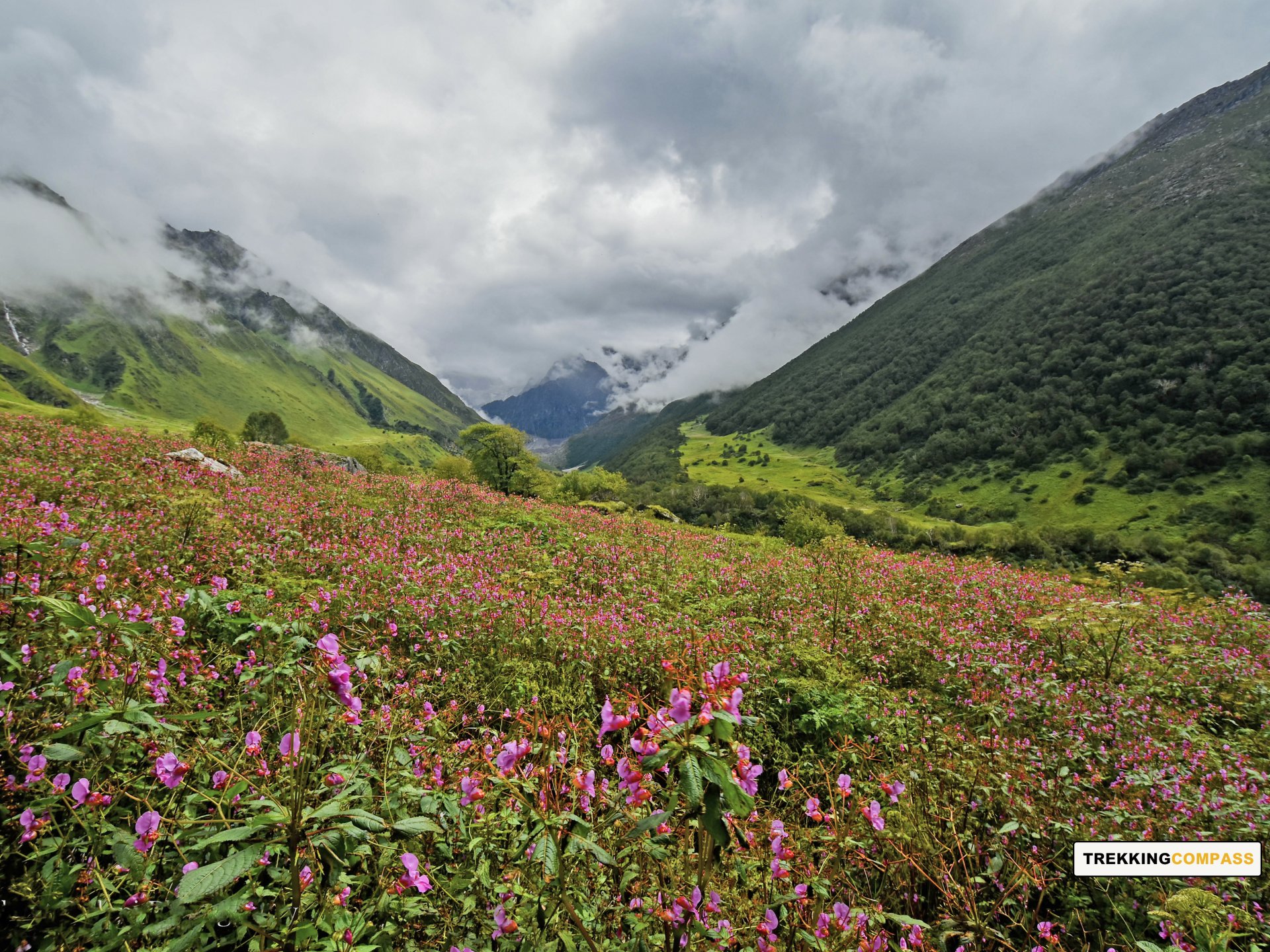
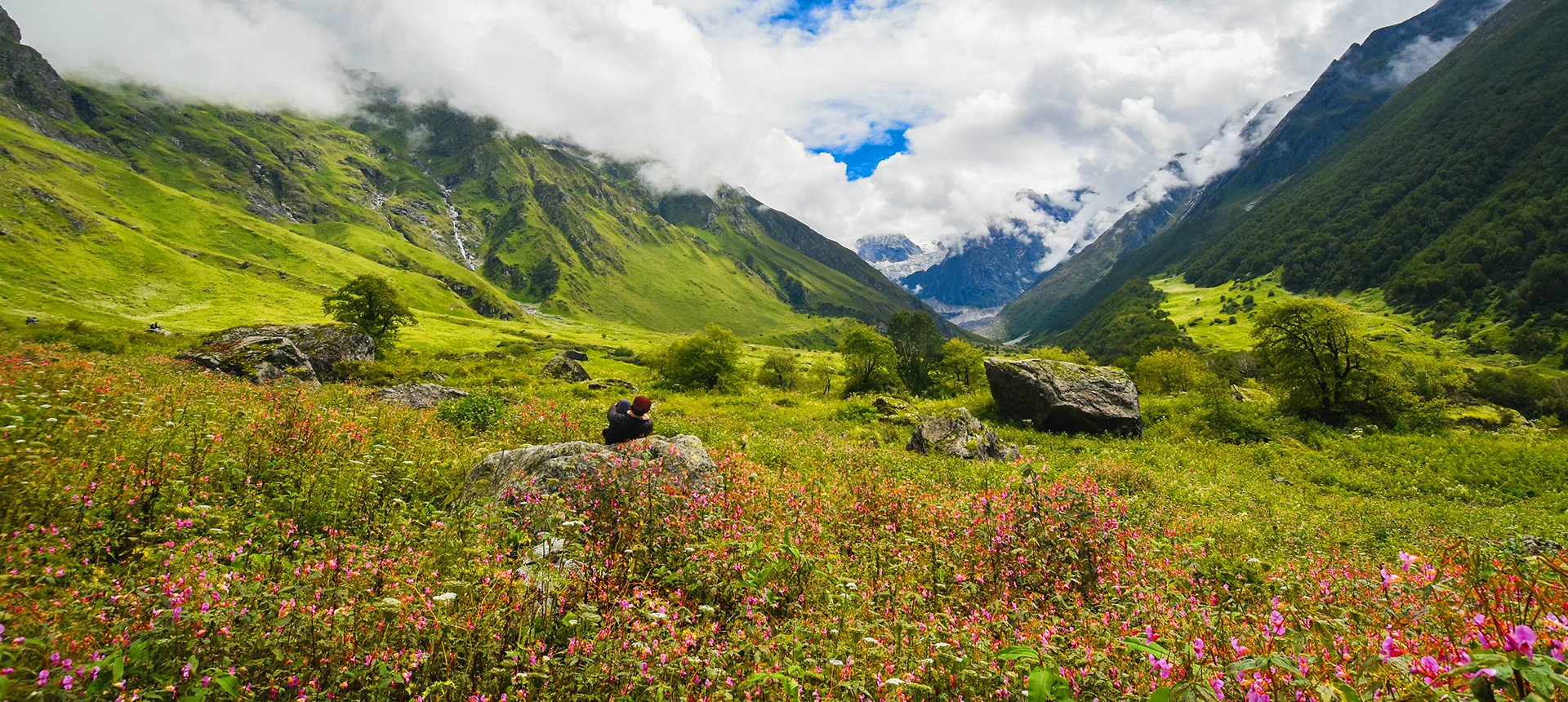
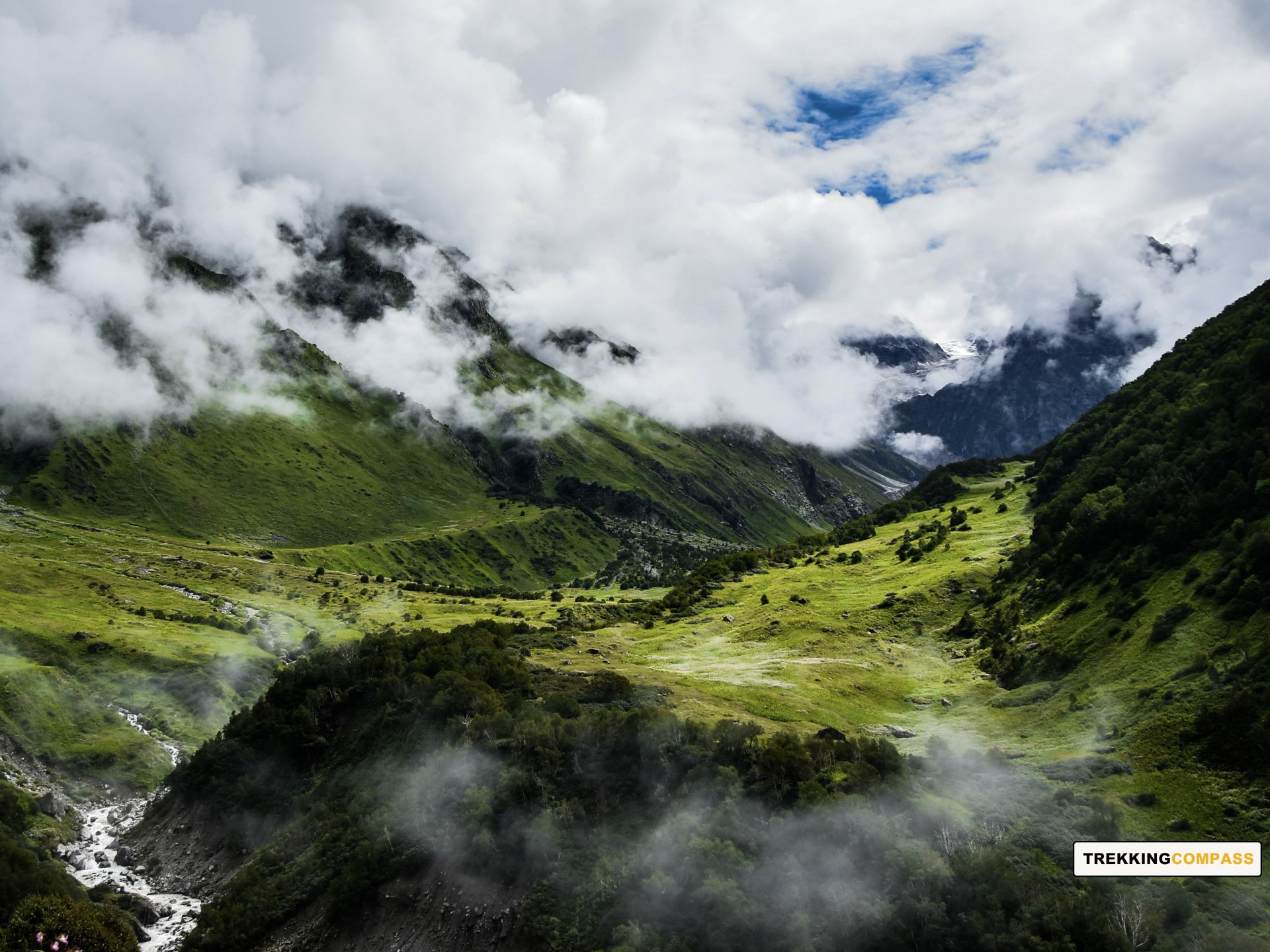
This trek is open from around 25th May to 11th October. These 5 months are when the flowers of this valley are in a bloom that appears everlasting. Every week, there is a new color sprawled over the valley. If you saw the valley pink this month, you might see it yellow the next one.
The Valley of Flowers is a 40 km-long trek at 11,600 ft with gifts like Hemkund Sahib Gurudwara (14,120 ft). Alongside this, you get a good hike, the streams, the lake, the Lokpal Lakshman Mandir, etc. This trek greets you with its arms wide open. Will you accept or not?
Sailang Altitude: 5,800 ft (1767 m)
Altitude Gain: 4680 ft (1426 m)
Travel Distance: 244 km
Travel Hours: 7 to 8 hrs (approx.)
The morning after trekkers have travelled to Rishikesh, the journey to Sailang will start. Sailang is a small village at approximately 244 km from Rishikesh. The drive there takes 7 to 8 hours, but the promising next day and the views make it a cakewalk.
Sailang is our stop. Others also choose Karchi, Joshimath, Auli, etc. From Sailang, your drive to the base village Pulna is an hour (max), and then we trek beyond that point. Sailang village humbles you with the enormous mountains standing in your view. One prominent view is of Mt Dronagiri. It's not completely visible, but its towering peak won't let you forget its presence.
While on your way to Sailang, you'll drive through spiraling hilly roads and pine trees lining the roads. These pine trees are fringed across the steep hills and even steeper valleys. Altogether, they remind you that beauty is in the finer details of nature. You'll pass through 4 Prayags on your way to Sailang. These are Devprayag, Rudraprayag, Karnaprayag, and Nandaprayag.
Once you reach Sailang after the long day's journey, you will get to rest at the lodging and acclimatize yourself. This will not be your last stop to rejuvenate, but an important one for tomorrow’s 10 km trek to Ghangaria.
Ghangaria Altitude:10,550 ft (3,216 m)
Altitude Gain: 4750 ft (1,448 m)
Travel Distance: 23 km (drive) + 4 km (drive) + 10 km (trek) = 37 km (approx.)
Travel Hours: 1 hr + 5 hrs = 6 hrs (approx.)
It's a special day as trekkers reach Ghangaria and witness Vishnuprayag. On the way to Govindghat, you pass Joshimath and around it, the 5th holy confluence. This confluence shows Dhauli Ganga merging into the Alaknanda River.
The day is a mix of a trek and a drive. An hour-long drive takes you to Pulna, and then after a 10 km trek, you are at Ghangaria. Ghangaria is a sort of base camp for both Valley of Flowers and Hemkund Lake Treks in the upcoming days.
The trekking trail from Pulna to Ghangaria is well-constructed and takes you to the world's highest Gurudwara. Valley of Flowers’ status as a National Park plays a role here too. Remember to carry the necessary documents to grab a pass for VOF tomorrow.
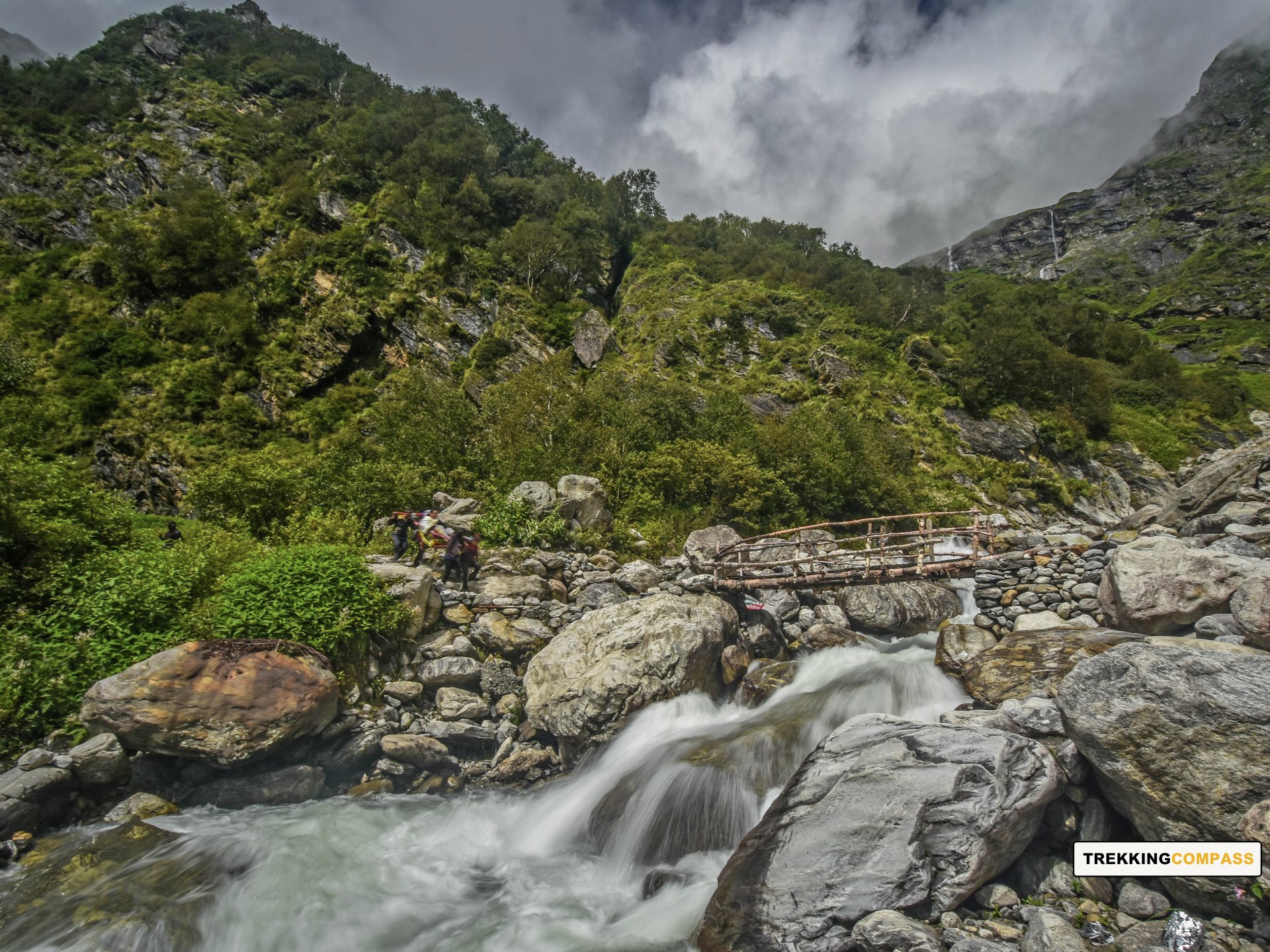
The trail is neutral for the most part, but it's steeper in the first 1 km and the last 4 km. Your pace should be steady throughout the trek to do these steep hikes without difficulty. This trail has trees, herbs, and shrubs to accompany you to Ghangaria. Alongside the trail, down in the valley, Lakshman Ganga flows and keeps you company throughout.
Special Note: There is no direct taxi from Sailang to Pulna. Trekkers will shift to local union taxis at Govindghat and enjoy the 4 km drive to Pulna.
Valley of Flowers Altitude: 11,600 ft (3536 m)
Altitude Gain/Loss: 1,050 ft (320 m)
Travel Distance: 4 km (🔺)+ 4 km (🔻) = 8 km (approx.)
Travel Hours: 3.5 hrs + 3 hrs = 6.5 hrs (approx.)
Today is an early bird’s day as Ghangaria closes the pass to Valley of Flowers after the clock strikes 12. Similarly, you must return from Valley of Flowers before 1:30 pm if you don’t want to be lost in the fog that settles in the valley after the designated time. The perfect time to start is around 6:30 to 7 am.
It's a round trek day with a 4 km ascent and a 4 km descent. In total, you cover 8 km in 6.5 hrs (approx.). Within the first 1 km of your trek, the sightings of popular plant species begin and you see Bhojpatra. It’s popular for its bark’s use as a paper in ancient times, even Vedas and Puranas were written on Bhojpatra.
The main meadows begin after you have crossed two bridges. An iron bridge where you cross the Pushpawati River. It is known to divide VOF into two halves. Another is a temporary wooden bridge called Bamandhaud.
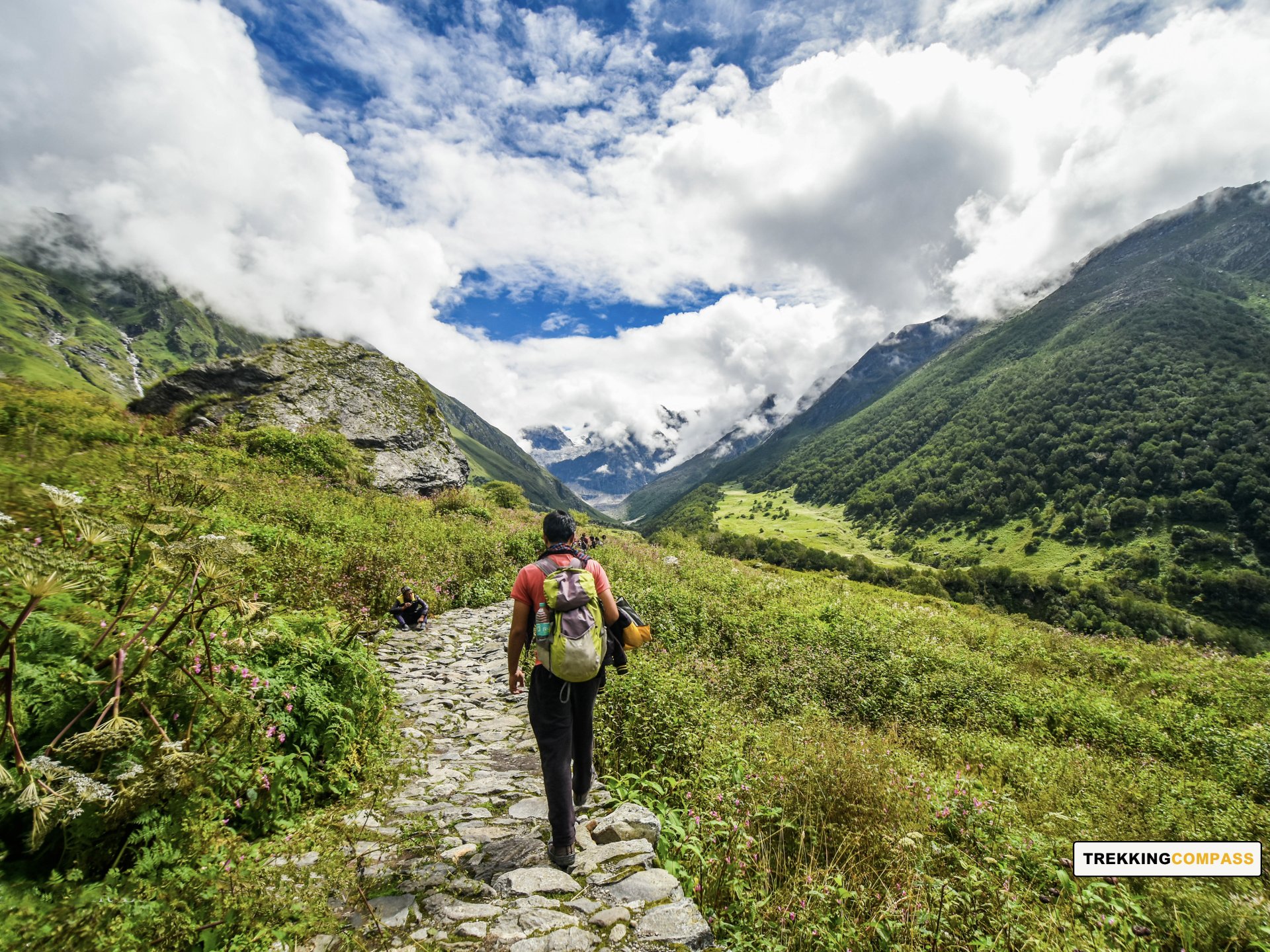
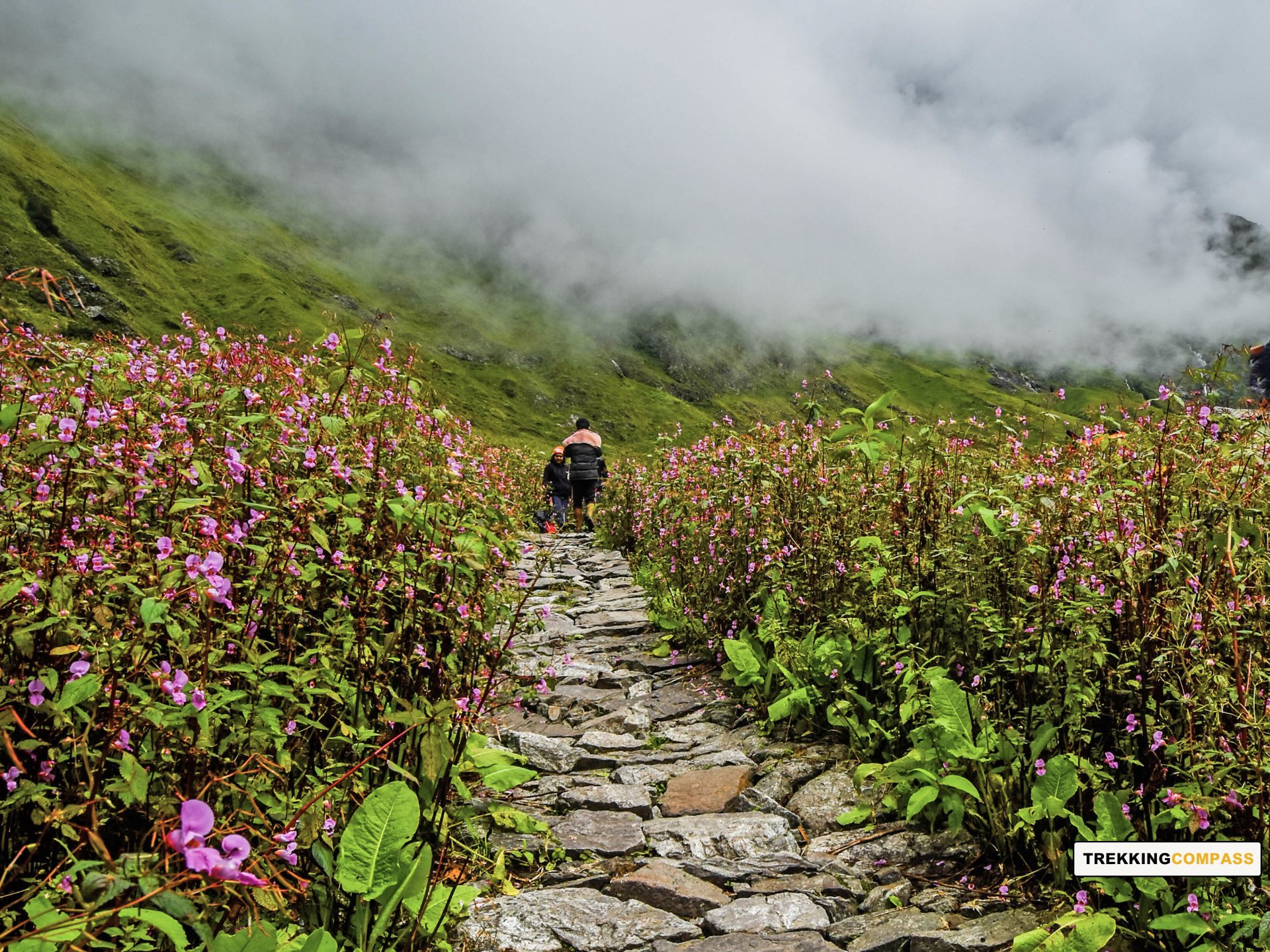
The trail to the Valley of Flowers is man-made and a raw and rocky land near certain places. The stones are not perfectly laid, so the sharp sides are up too. While walking to the Valley of Flowers, ensure you're not in a hurry or you will drain your energy.
In the Valley of Flowers, you have 7 km long and 4 km wide meadows to explore. It is surrounded by peaks like Hathi and Ghoda Parwat. The highest peak in the Bhyudhar Valley or the Valley of Flowers is the Gauri Parwat at 22,000 ft. The views are mesmerizing in the hues of pink, yellow, purple, red, and violet. The floral species in the valley change at every step you take, it is rich in biodiversity.
A 4 km trek further into the valley, you can see the glacier where the Pushpawati River emerges, it’s a natural wonder one should witness. The Valley of Flowers is Dev Indra’s Garden of ancient times and also the Nandan Kanan mentioned in the Puranas. This Apsara Bhumi (Fairy Land) is home to the happy and sad stories of two Britishers. A mountaineer, Frank Smythe’s happy story of discovery, and a botanist, Lady Joan Legge’s sad story of being discovered.
Hemkund Altitude: 14,120 ft (4,304 m)
Altitude Gain/Loss: 3,570 ft (1,088 m)
Travel Distance: 6 km (🔺) + 6 km (🔻) = 12 km (approx.)
Travel Hours: 4.5 hrs + 4 hrs = 8.5 hrs (approx.)
The trek hours for today are around 8 to 9 hours. Rewarding as it is, the trek to Hemkund Lake is moderately difficult, which makes it more challenging than yesterday's trek to the Valley of Flowers. You should have a poncho and a windcheater at all times, as the temperature gets freezing at Hemkund Lake (14,120 ft).
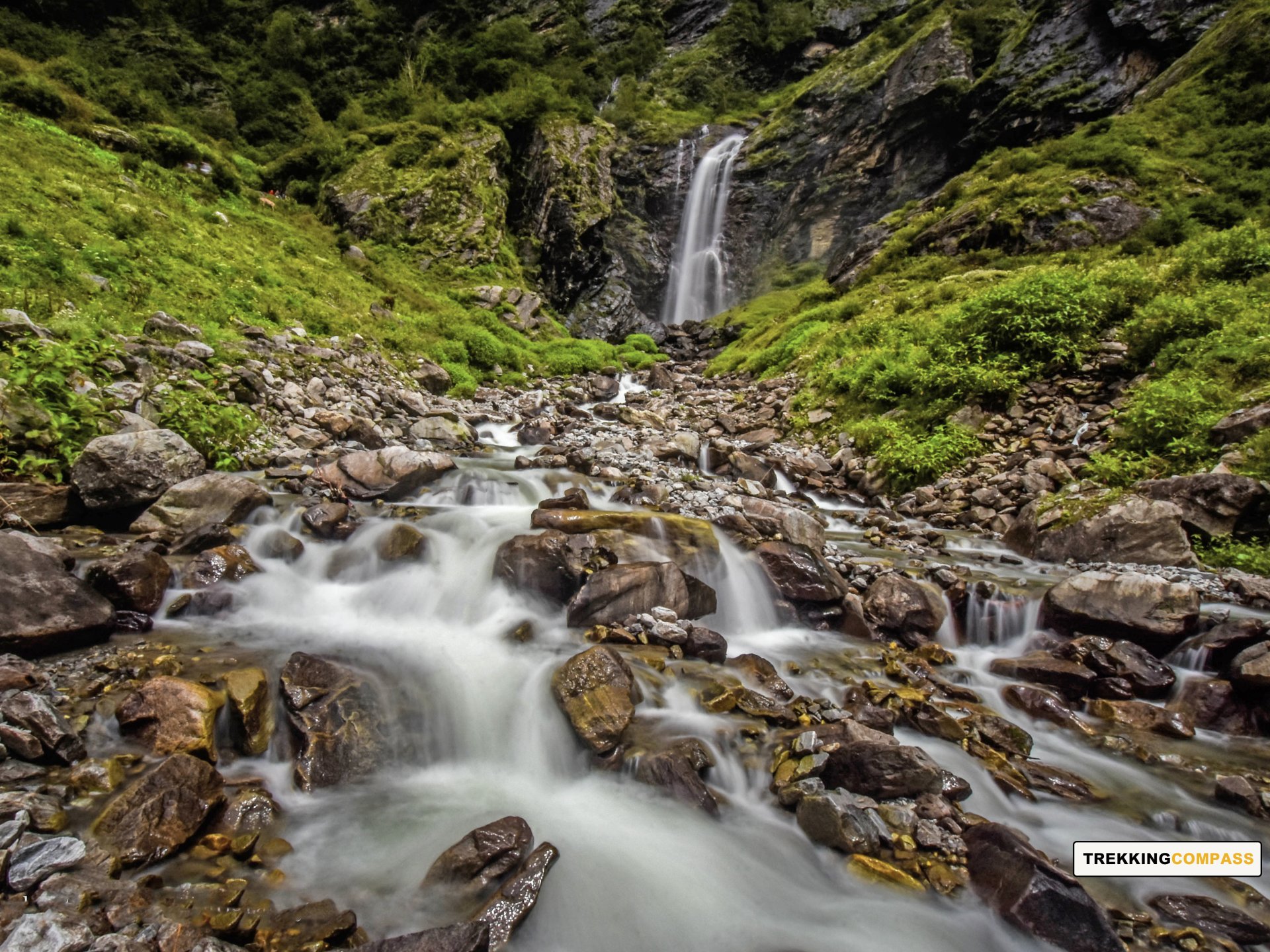
On your trek up to Hemkund Sahib, you will encounter more crowds than VOF, so tread likely. The trail has dhabas where you can get some quick snacks or drinks. The trek begins with a beautiful waterfall originating from Hemkund. The Lakshman Ganga River looks more beautiful falling down that high point.
The trail is man-made, even cemented, wherever possible. It has railings for support and benches where devotees can rest. As you trek up the last 3 km, you start to feel the lack of oxygen, thus you must acclimatize well.
Soon you reach the glacier and cross the path lying in the way of the melting glacier. Be careful while crossing it. As you ascend higher, more and more mountains with white snow become prominent, painting the perfect background for oak trees. It's like they are straight out of paintings.
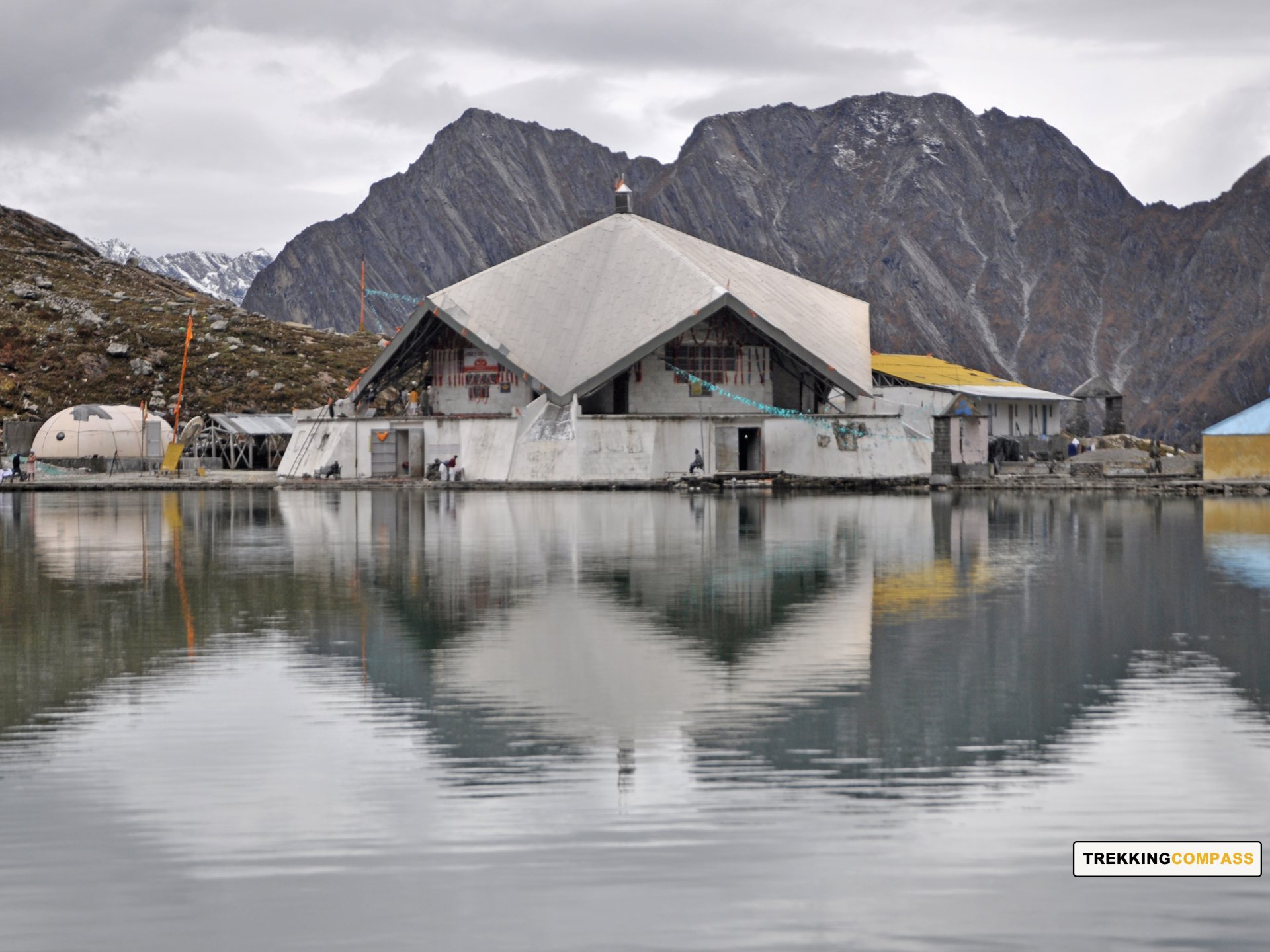
Amongst the towering mountains, you'll soon spot a man-made building. Here's where you know you are almost there. Gurubani’s voice from the Gurudwara is like music to your freezing ears.
At the Hemkund Sahib, you get warm water to unfreeze your feet and hands. You get parshada (Gurudwara food) to fulfill your hunger at the Gurudwara. This place is dedicated to Sikh guru Guru Govind Singh, he is said to have meditated here in his previous birth Dusht Daman. Hemkund Lake is guarded by seven peaks rarely visible due to the fog.
For Hindu Devotees, the place has Lokpal Lakshman Mandir, the highest Lakshman Mandir in the world. Devotees believe that Sheshnag’s penance here got him the blessing of being with Lord Vishnu at all times. In Shree Krishna Avatar as Balram, with Shree Ram Avatar as Lakshman, etc.
Hemkund shows how two religions coexist, beautifully and not as a threat, but as a treat to each other. Sitting there, taking in the views, and being grateful for this life experience is a blessing.
Sailang Altitude: 5,800 ft (1767 m)
Altitude Loss: 4,750 ft (1,448 m)
Travel Distance: 10 km (trek) + 4 km (drive) + 23 km (drive) = 37 km (approx.)
Travel Hours: 4.5 hrs + 1 hr = 5.5 hrs (approx.)
After your trek to two of the most beautiful destinations, this is the day to trek down to Pulna. The 10 km descent from Ghangaria is steep in some places and plain in others. The same stopping points greet you on this man-made, cemented trail. There are quite a few dhabas where you can rest and continue further. Refreshments like drinks, packed food, and Maggie are available at these stops.
There are two stops on your trek down to Pulna. At 5 km, you have Bhyundhar Village (here you cross Lakshman Ganga too). Later on, after another 3 km descent, you reach Jungle Chatti, a small market of dhabas. Nothing fancy, just some tasty local food.
Once you are at Pulna, you are no longer required to trek. You can opt to walk 4 km from Pulna to Govindghat. Govindghat is where Lakshman Ganga merges into Alaknanda and becomes Alaknanda. Finally, its Ganga at Devprayag.
Special Note: There is no direct taxi from Pulna to Sailang. Trekkers will shift to local union taxis at Govindghat and enjoy the 4 km drive to Sailang. Make a quick shift without any hysteria, and trust the locals.
Rishikesh Altitude: 1,120 ft (340 m)
Altitude Loss: 4680 ft (1426 m)
Travel Distance: 244 km
Travel Hours: 7 to 8 hrs (approx.)
You will wake up to a quaint sunrise at Sailang and leave for Rishikesh today. This day will not be as adventurous, but it will be worthwhile. You have all the memories to reminisce, be it the 4 Prayags en route or the 5th Prayag you rewatched yesterday. This trek lacks the camps but not the sites and milestones. You get glimpses of the different flower species from the Valley of Flowers that bring occasional smiles to your face.
Many of you will plan to return and take in what’s left. These exotic flower species and the valley’s vast grassland call for a return. Then the mountains tower and surround the valley, making you feel protected and cared for. It’s a lengthy trek and serves you more than it seeks, making it a likable trek among trekkers. You will not disagree with this fact while returning to the chaos of home and work.
Memories will follow, but on your return drive, there are views and points of stop too. Apart from the rich darshans of 4 confluences, you also have mandirs for devotees. These considerable stop points are Vridh Badri Temple, Siddhanta Temple, Dhari Devi Temple, and Shree Garuda Temple. If you have time and enthusiasm, Badrinath Dham isn’t far from here and you can visit it. There are tons of possibilities if you have the time.
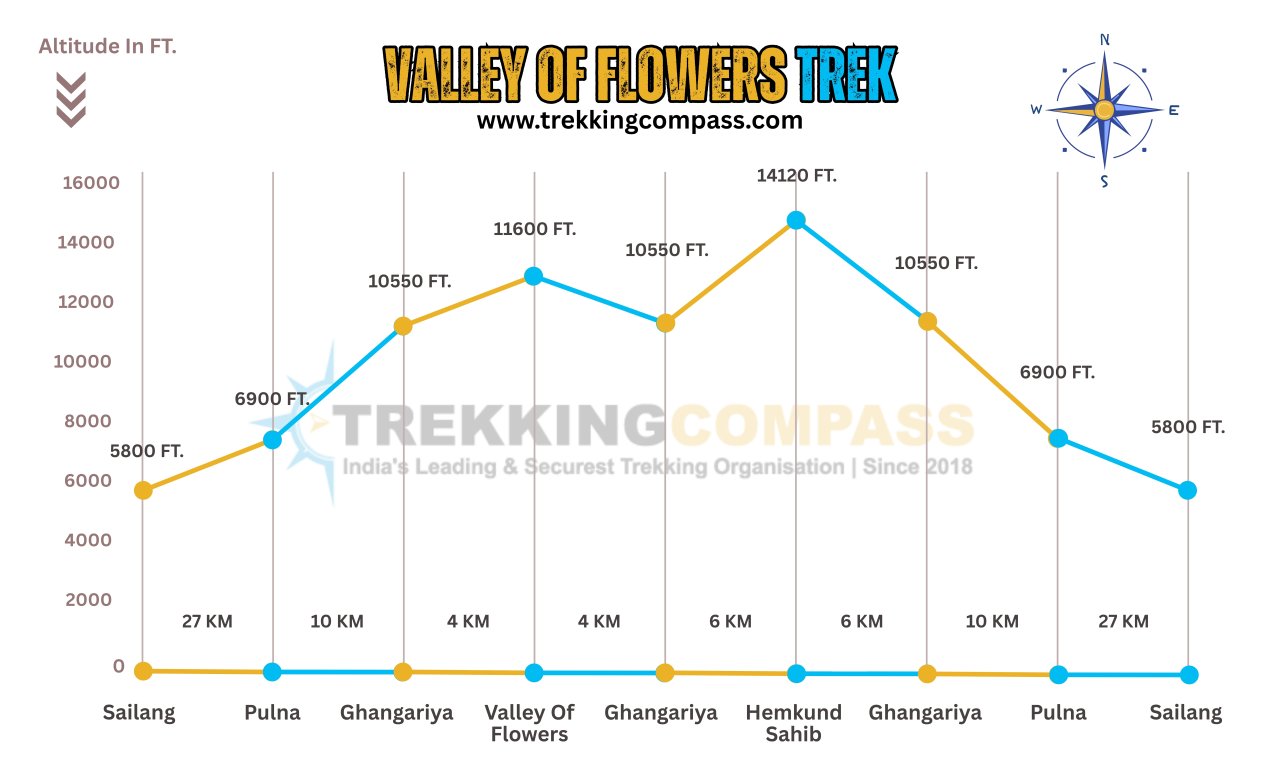
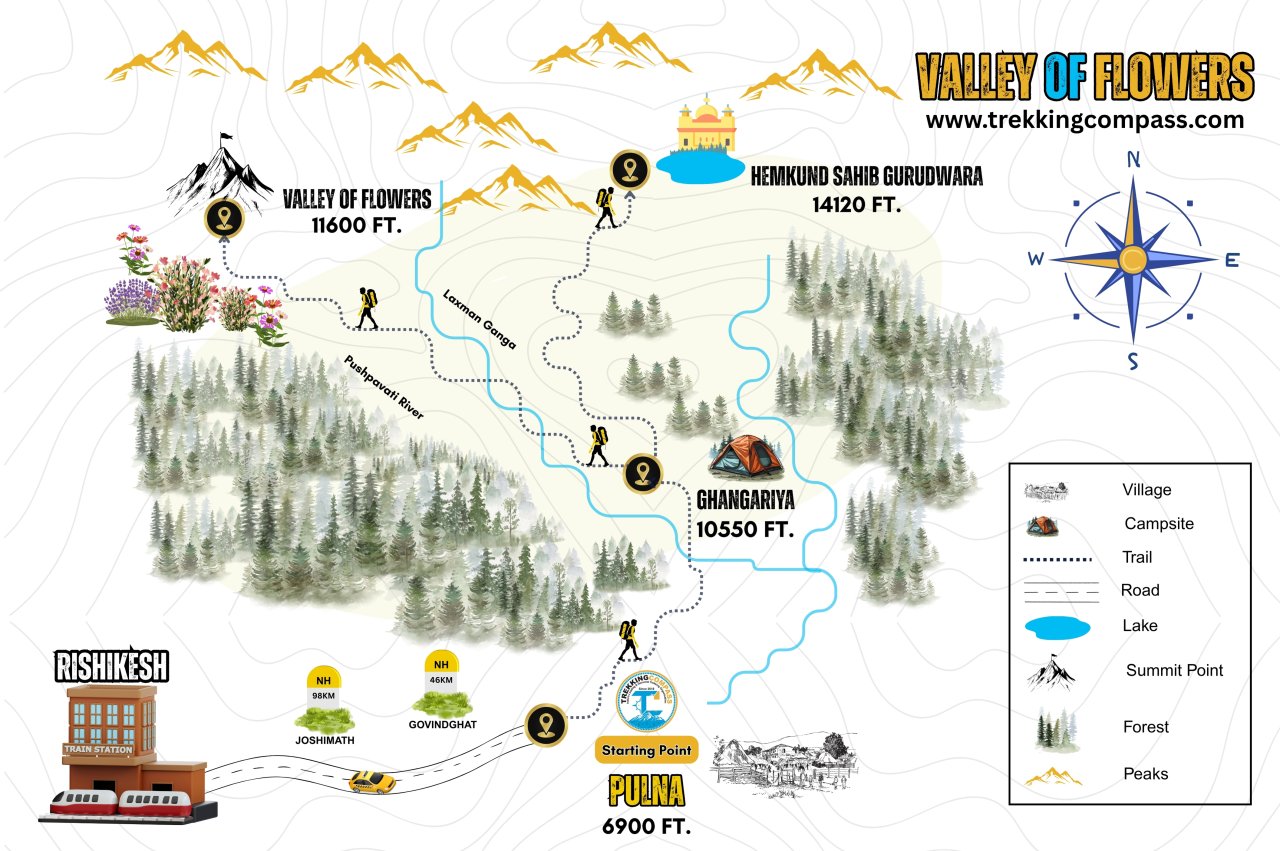
Valley of Flowers Trek Elevation Chart & Route Map
Accommodation
Meals (Vegetarian only with eggs option available)
Nutritious meals from Day 1's dinner to last day's breakfast, following the itinerary schedule.
Expert Support
First Aid Preparedness
Fully equipped medical kit including a stretcher, oxygen cylinder, blood pressure monitor, oximeter, and stethoscope to ensure safety throughout the journey.
Storage Facilities :- A secure room at the base camp to store additional luggage not needed during the trek.
Permits and Entry Fees :- Coverage of all necessary permits and entry fees, in line with standard charges for Indian nationals.
Transportation :- A round-trip transport from the pick-up point and back at the same point as a part of the itinerary.
Trek Equipment
Insurance :- Personal insurance is mandatory and not included in the package.
Personal Expenses :- Any expenses of a personal nature, including shopping, snacks, hiring a mule or porter for carrying your belongings, or acquiring personal equipment.
Emergency Costs :- Expenses arising from emergency evacuations, hospitalization, or any medical treatments required.
Unspecified Services :- Any services or items not explicitly mentioned under the "INCLUSIONS" section.
Food Costs :- We will not cover any food costs during your transit to and from the base village.
Trekking is not only about enjoying the change of scenery but also about being responsible. Our (Trekking Compass) responsibility is to provide you with an opportunity for a safe trek. But, how do we do that? We do that when you fulfill your end of the responsibility and are honest with us. To keep you safe we need to be sure there isn’t any inherent threat to your being.
Treks are at higher altitudes and it becomes difficult, almost impossible to provide you with immediate medical assistance. Therefore, we cannot help you if you don’t help us. Trekking is only one of the things you can do, but there are plenty of other things to do too. Don’t risk your life for the thrill.
To approach a trek with utmost safety, we want you to submit the following documents:
Personal Confirmation Statement (Compulsory for anyone over 18 years)
You are participating in a trek at high altitudes and it comes with its own sets of risks. This Personal Confirmation Statement will make sure that you understand all the risks you're buying into. Trekking Compass wants you to confirm your complete understanding of these risks so that you come prepared for any mental or physical challenges ahead.
This statement is also a declaration from you that, "All the information I have provided, including medical conditions, is true. If found false under any circumstances, I will be held accountable and it has nothing to do with Trekking Compass."
We have the utmost empathy for you and will do our best to help wherever possible, but only after assessing your readiness and safety for the trek. This is how our team will adequately prepare for whatever risks we might face during the journey. Concerning individuals are requested to thoroughly cross-check the requirements and only then sign the document.
Parent/Guardian Approval Statement (Compulsory for anyone below 18 years)
For participants under 18 years of age, the Parent/Guardian Approval Statement is essential to confirm that a legal guardian understands and consents to the participation in the trek. Once we have this document, we are affirmed that the parent or guardian is fully aware of the risks involved in trekking at high altitudes and is consenting to their child's participation.
No underage (below 18+) children are welcome on the trek without their parent's consent. Submission of this document reassures us that parents are approving that their child meets the health and fitness requirements for the trek, after a thorough examination.
This legal confirmation holds the parent liable for any discrepancies, freeing Trekking Compass from any liabilities for the same. Parents are requested to thoroughly cross-check the requirements and only then sign the document.
Medical Liability Waiver
The Medical Liability Waiver makes sure participants acknowledge the health risks associated with trekking at high altitudes. Common ailments during treks include altitude sickness, dehydration, muscle cramps, hypothermia, and fatigue, all of which can significantly affect your trekking experience. Additionally, weather changes and the physical demands of the terrain may exacerbate pre-existing conditions.
If you have pre-existing medical conditions such as asthma, diabetes, or heart issues, it’s vital to inform us and carry your necessary medications. Trekking Compass cannot provide immediate medical assistance in remote areas, so having the essential medications, such as inhalers, insulin, or any other prescriptions, is crucial for your safety during the trek.
By signing this waiver, you confirm that you are in good health and have taken the necessary precautions. You acknowledge these risks and agree not to hold Trekking Compass liable for any medical issues or accidents that may arise during the trek.
For any further doubts about anything mentioned above, below is our contact information:
OFFICE ADDRESS: Lane No. 4 Krishna Vihar Mohkampur, Dehradun, Uttarakhand, 248005
PHONE NUMBER: +91 7055048487, 7055048488
EMAIL ADDRESS: info@trekkingcompass.com
HOW TO REACH ? (RISHIKESH)
Note: Keep a buffer day in your getaway in addition to the total days in the itinerary. This day will come in handy in case of any political unrest, landslides, or rains. If not, you can use the extra day to get to know Rishikesh. This means that for an itinerary ending on the 15th of a month, book your return tickets for the 16th.
What are the different ways to reach Rishikesh?
On the Valley of flowers , our first long-day trip is from Rishikesh to Joshimath (244 km). Therefore, trekkers need to reach Rishikesh to start the trek. The first move to reach Rishikesh for any trekker is to reach either Dehradun or Delhi. Later, every trekker can choose their choice of transport. The available transports for Rishikesh are:
Medium: BUS
A Friendly Note: You should travel by government buses instead of private ones because the private buses tend to take more time than expected. To avoid missing the pick-up time, try traveling by government bus, wherever possible.
Medium: TRAIN
Medium: FLIGHT
Fly Directly to Dehradun and then to Rishikesh: To fly directly at Jolly Grant Airport Dehradun, there are multiple flights from metropolitan cities. The companies that facilitate these flights are:
Fly to Delhi then take a bus or train to Rishikesh: It’s very easy to fly to Delhi from anywhere in the country and take a bus to Rishikesh. You will find a detailed description of buses in the BUS section. The companies that facilitate these flights to Delhi are:
Note: Make sure that the mode of transport you choose should bring you to Rishikesh a day before Day 1, i.e., Day 0. You can fly to Delhi and Dehradun from Mumbai, Kolkata, Bengaluru, Chennai, Hyderabad, Pune, and to Dehradun from Delhi too.
What happens on the drop-off day
Here are the points that explain your drop-off:
Special Case: What if you miss our pick-up?
You shouldn't panic and follow one of the below-mentioned ways to Lohanjung:
| Backpack with rain cover / Trolley Bag | Main bag for gear. |
| Day pack with rain cover (20 - 30 L) | For day essentials, if the main pack is off-loaded. |
| Walking stick | Recommended (at least one). |
| Water bottle/ Hydration pack | 2 bottles (1L each) or 1 hydration pack and 1 bottle. |
| Snacks | Energy bars, dry fruits, ORS/electrolytes. |
| Personal Medical Kit | As prescribed by your doctor. |
| T-shirts (Synthetic, quick-dry) | 2 full-sleeve, 2 half-sleeve. |
| Fleece T-shirts | 2 pieces. |
| Wind-stopper / Fleece jacket (upper) | 1 piece. |
| Windproof jacket | 1 piece |
| Down feather / Hollow jacket | 1 piece |
| Thermal innerwear (Upper & Lower) | 1 set. |
| Trekking pants (Synthetic, quick-dry) | 3 pairs. |
| Wind-stopper / Fleece pants (lower) | 1 pair. |
| Waterproof gloves | Not required. |
| Fleece / Woolen gloves | 1 pair. |
| Poncho / Waterproof jacket and pants | 1 set. |
| Head torch / Hand torch | 1 piece. |
| Sun cap | Required. |
| Woolen cap | 1 piece. |
| Balaclava | 1 piece. |
| Buff/ Neck gaiters | 1 synthetic, 1 woolen. |
| Sunglasses | UV protection with side covers (for spectacle users: contacts or photochromatic lenses). |
| Trekking shoes (waterproof, high ankle, good grip) | 1 pair. |
| Floaters / Flip-flops | 1 pair. |
| Cotton socks | 4 pairs. |
| Woolen socks | 2 pair. |
| Sunscreen | 1 piece. |
| Moisturizer | 1 piece. |
| Lip balm/ Chap-stick | 1 piece. |
| Toothbrush and toothbrush | 1 set. |
| Toilet paper and wipes | 1 pack each. |
| Soap/ Hand sanitizer | 1 piece. |
| Quick-dry towel | 1 piece. |
The Valley of Flowers Trek is one of the most celebrated Himalayan treks in India, located in Chamoli district, Uttarakhand, within the Nanda Devi Biosphere Reserve (UNESCO World Heritage Site). As the name suggests, it is a vast alpine valley bursting into a riot of colors during monsoon, with over 500 species of flowers including blue poppies, primulas, orchids, and the rare Brahma Kamal. Beyond its botanical richness, the valley is surrounded by snow peaks like Nilgiri Parbat, Rataban, and Gauri Parbat. The trek also carries spiritual significance, as many believe this is the valley where Hanuman brought the mythical Sanjeevani herb for Lakshman in the Ramayana. It is truly a trek that combines nature, spirituality, and Himalayan grandeur.
The trek is open only from June to September, and each month offers a different experience:
Unlike other treks that are avoided during monsoon, the Valley of Flowers is at its best during rains, making it truly unique.
It is considered an easy to moderate trek, suitable for beginners. The trail is well-defined and does not involve technical climbing. However, the trek involves long walking days of 6–7 hours with steady ascents, especially the climb from Ghangaria to the valley. Since it rains often, trails can be slippery, requiring good shoes and balance. Compared to high-altitude treks like Kedartal or Satopanth, Valley of Flowers is much more accessible and family-friendly.
The trek is about 37 km round trip and usually takes 6 days, including travel. The trek begins at Govindghat (1,828 m), then progresses to Ghangaria (3,050 m), which serves as the base camp for both Valley of Flowers and Hemkund Sahib. From Ghangaria, it is about 4–5 km each way into the valley.
The Valley of Flowers itself lies at 3,500–3,600 m (11,500–12,000 ft). Many trekkers also combine this trek with Hemkund Sahib (4,329 m / 14,200 ft), a Sikh pilgrimage site, which involves a steeper climb but is equally rewarding.
No. The trek is very suitable for first-time trekkers, families, and even senior citizens with good fitness. The trail is not overly steep, and accommodation in Ghangaria makes it more comfortable than camping treks. Still, one must prepare for long walks, unpredictable rain, and altitude adjustments.
You should be able to walk 6–8 km daily with moderate stamina. Pre-trek preparation can include brisk walking, jogging, yoga, or stair climbing for 3–4 weeks. Since rain and slippery stones add difficulty, a good sense of balance and proper trekking shoes are important.
The valley is deeply rooted in Hindu mythology. According to legends, Hanuman came here in search of the Sanjeevani herb to save Lakshman during the Ramayana. Locals believe the valley is a celestial garden of fairies and deities. Moreover, nearby Hemkund Sahib, a high-altitude Sikh shrine, adds a spiritual aura to the region. This unique blend of mythology and natural wonder makes the trek not just scenic but also spiritually enriching.
Unlike most treks where camping is the norm, here accommodation is available in guesthouses and lodges at Ghangaria. Facilities are basic but comfortable, with rooms, beds, and food provided. No one is allowed to stay inside the Valley of Flowers overnight — trekkers must return to Ghangaria the same day.
Yes. The valley is part of a protected national park, so Trekking Compass will take care of an entry permit from the forest office at Ghangaria checkpoint.
The trek begins at Govindghat (1,828 m).
The valley lies at 3,600 m, so the risk of AMS is low to moderate. Most trekkers acclimatize well, especially since the first night is spent at Ghangaria (3,050 m). However, if you extend to Hemkund Sahib (4,329 m), the steep ascent can cause breathlessness or mild AMS. It is advised to ascend gradually, drink water frequently, and rest whenever needed.
Yes, it is one of the safest Himalayan treks. The trail is well-marked, guesthouses provide shelter, and the valley sees thousands of trekkers and pilgrims each season. The only risks are slippery stones during rain and altitude fatigue at Hemkund Sahib. With good shoes, rain gear, and pacing, the trek is safe even for beginners.
Because it is a once-in-a-lifetime experience — a natural paradise that is open only for a few months a year. Unlike rugged adventure treks, this one combines comfort (guesthouses at Ghangaria), cultural depth (Hemkund Sahib, Ramayana legends), and ecological richness (500+ species of flowers). If you want to witness the Himalayas’ softer, colorful side while still enjoying grand peaks and alpine valleys, the Valley of Flowers Trek is unmatched.
Yes. The trek is suitable for beginners and even families. Generally, participants between 8–60 years can join, provided they are medically fit and prepared for 6–7 days of trekking in the mountains.
And there are different rules for different sets of children. They are:
For both sets, Medical and Disclaimer forms are compulsory on the trek.
Preparing for Valley of flowers trek means:
Our trek leaders are trained in first aid and equipped with oxygen cylinders and stretchers. The nearest medical facilities are available at Sailang, and evacuation arrangements are made if required. Travel insurance covering trekking is strongly advised.
Yes, trekkers who don’t wish to carry their backpack can opt for mule/porter services at an extra cost. This allows you to trek light while still enjoying the Valley of Flowers experience.
Handpicked routes with strong scenery, reliable pacing, and a premium featured block that still stands apart from the rest of the archive page.
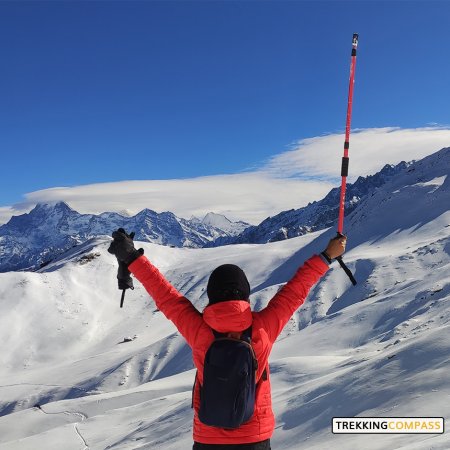
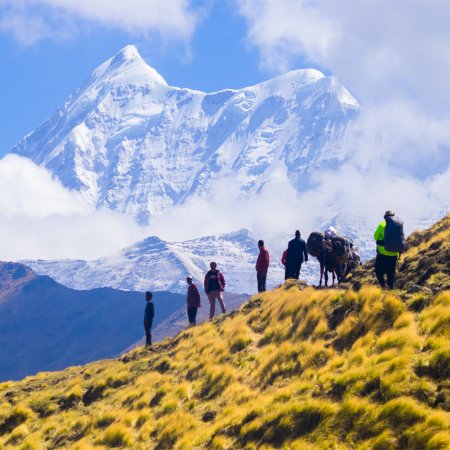
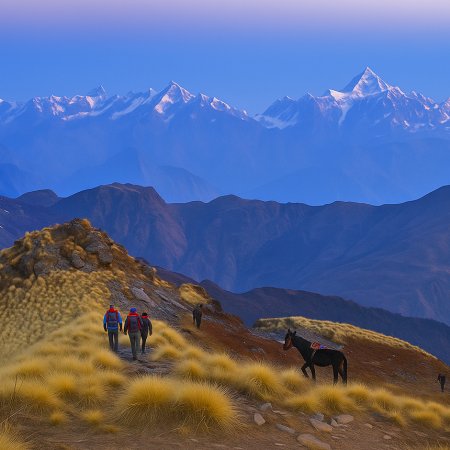
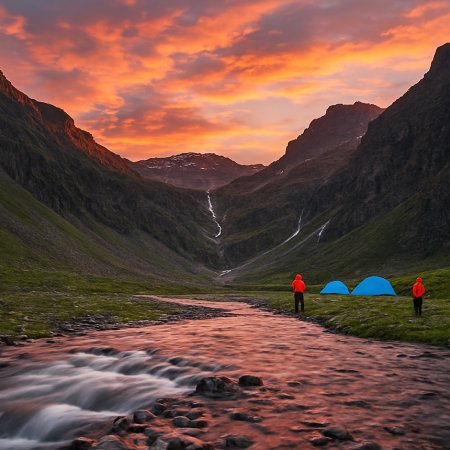
Crafted routes, reliable execution, and a trekking experience that feels premium from planning to summit.
 Safety
Route checks, first-aid readiness, and trained leaders to keep every step confident.
 Routes
Better pacing, better camps, and real acclimatization designed for experience, not speed.
 Groups
Less crowd, more care so you enjoy the trek, not just finish it.
 Trust
Trust
Clear inclusions, no hidden surprises, and real human support on WhatsApp.